
Originally Posted On: https://blog.coastalmarinegroup.net/why-composite-is-reshaping-boat-dock-construction-for-long-term-waterfront-use/
Key Takeaways
-
Choose the right boat dock construction type before you pick decking, because floating docks, stationary docks, and dock pilings each handle Cape Coral water, wake, and vessel use very differently.
-
Compare composite against wood over 10 to 20 years, not just at install, since boat dock construction cost often rises later through board replacement, fastening issues, and repeat upkeep.
-
Check the structure below the deck first—dock piling installation, post spacing, framing, and hardware usually decide whether a dock stays level and safe or starts moving, sagging, or pulling apart.
-
Plan boat lifts, lighting, water lines, and canopy loads during boat dock construction, because adding them after the fact usually means extra labor, torn-up decking, and avoidable structural changes.
-
Review dock building plans closely before permits go in, especially seawall tie-ins, landing width, water depth, and side access, because those details affect approval, function, and resale appeal.
-
Invest in long-life dock designs instead of chasing the cheapest way to build a floating dock, since serious waterfront homes benefit more from fewer repairs, cleaner looks, and better daily use.
A dock can make a waterfront home feel finished—or make it feel like a repair project parked behind the house. In Cape Coral, boat dock construction isn’t just about getting from the seawall to the boat; it affects upkeep, curb appeal, resale strength, and how often owners end up swapping cracked boards after another brutal summer. That part gets missed all the time.
Composite decking has changed the conversation.
Not because it’s trendy, and not because a brochure says so, but because salt, sun, wake, and wet feet punish weak deck surfaces fast. A pretty dock that turns soft, splinters, or fades out in a few seasons isn’t a smart build—it’s a mistake with a water view. For canal homes, riverfront lots, and harbor-side properties, the better question isn’t just what looks good today. It’s what still looks right—and still feels solid—10 or 15 years from now.
Boat dock construction in Cape Coral starts with the right dock type and site plan
On a Cape Coral canal, two neighboring homes can need two totally different docks—one for a 24-foot center console in calm water, the other for a larger vessel near heavy wake and tighter landing access. Smart boat dock construction starts with the site, not with deck boards or ideas pulled from a lake or farm pond layout.
Composite vs wood in boat dock construction for canal, river, and harbor-front homes
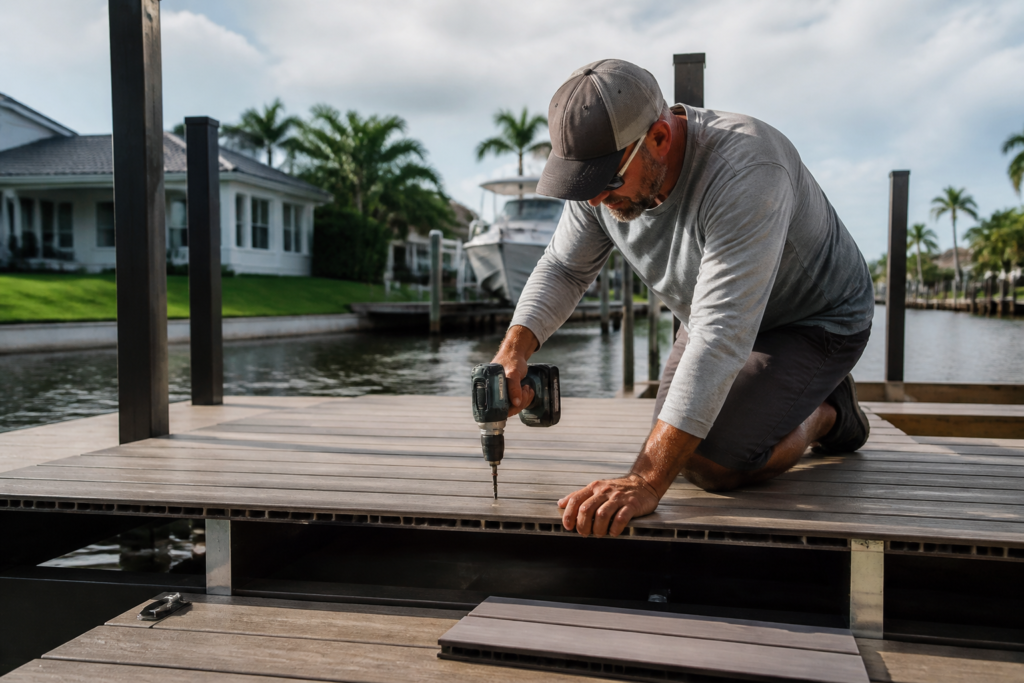
Composite decking holds up better in Southwest Florida sun, salt, and wash. Wood can look good at first, but it splinters, fades, and needs more upkeep. Homeowners searching for boat dock contractors near me usually want the same thing: a clean front edge, low maintenance, and a dock that still looks right years later.
Floating docks, stationary docks, and dock pilings: the difference that affects lifespan
Not all docks belong on pilings. A floating setup can work for a small pond, low-freeboard launch, or special access point, but most canal, river, — harbor-front homes do better with a stationary dock tied to solid posts. That difference matters. It affects lifespan, deck height, and how the structure handles drive-up loads from boats and wakes.
Water depth, vessel size, wake exposure, and landing access before you build
Before plans are drawn, a contractor should check four things (and check them in person):
-
Water depth at low tide
-
Boat size and lift needs
-
Wake exposure from canal traffic or open side water
-
Landing access for boarding, shore power, and safe steps
That is why dock construction evaluation services matter before building starts.
Why composite decking is changing boat dock construction cost over the long haul
Composite changes the math. In boat dock construction, the cheap board usually gets expensive fast—after cracked deck boards, popped fasteners, sanding, stain, and repeat labor stack up across 10 to 20 years. For homeowners comparing boat dock construction near me, that long-view cost matters more than the first invoice.
Upfront dock cost vs repair cycles, board replacement, and upkeep over 10 to 20 years
Wood still wins the first-round cost test. Not for long. On a 30 foot stationary dock or pier extension, composite often cuts board replacement cycles hard, especially on a working deck that sees coolers, carts, dock boxes, and wet foot traffic every week. Good boat dock contractors usually show owners two paths: lower first cost with more upkeep, or higher first cost with fewer repair calls.
-
Wood: more sealing, more fading, more split boards
-
Composite: fewer surface repairs, steadier color, less routine upkeep
Heat, slip resistance, fading, and saltwater wear on a working deck near the water
Not all composite boards perform the same—and that’s where design choices matter. Some run hot in full Southwest Florida sun. Some have better slip texture, better fade control, and better saltwater wear near pilings, lifts, and side landings (especially on Gulf-access docks where spray never really stops).
Where composite fits best in 30 foot dock plans, pier extensions, and multi-slip designs
Composite fits best where traffic stays heavy. Think 30 foot dock plans, front walkways, ship-style finger piers, and multi-slip docks where posts, framing, and dock pilings stay put but deck boards take the abuse. For owners planning residential dock building, composite usually makes the most sense on the main walking surface—not every square foot.
Boat dock construction details that decide whether a dock holds up or fails
How does a homeowner know if a new dock will stay straight, stay safe, and keep working after years of tide, wake, and storm surge? In Southwest Florida, boat dock construction fails for plain reasons: weak pilings, loose framing, bad hardware, and lift loads that weren’t planned early enough.
Dock piling installation, post spacing, and driving pilings for a dock in Southwest Florida soils
Start below the waterline. Canal muck, sand, and mixed soils change how crews handle dock pilings—and a pretty deck won’t save a bad base. Proper post spacing matters; too wide, and the frame starts to flex.
Homeowners searching for boat dock builders near me should ask how deep the pilings are driven, what size posts are used, — whether the layout fits the boat, not just the lot.
-
Pilings: size and embedment must match soil and vessel load
-
Spacing: tighter layouts usually hold up better
-
Drive method: the goal is refusal—not guesswork
Framing, hardware, and connections between deck boards, joists, and lift areas
Here’s what gets missed—connection points. Joists, deck boards, brackets, and through-bolts take daily stress from foot traffic, wave action, and lift movement. In salt air, cheap hardware rusts fast (faster than most owners expect).
Anyone comparing dock construction near me should look at framing plans, hardware grade, and how the lift bay ties back into the main dock frame.
Boat lift loads, utility runs, lighting, and canopy planning during dock building
Boat lifts change everything. A 10,000-pound lift—or larger—needs load paths planned before deck installation, not after. Utility runs for water, power, lighting, — canopy posts should be placed early—otherwise crews end up cutting finished work later. That’s expensive. And sloppy.
It’s not the only factor, but it’s close.
Boat dock construction permits, design choices, and builder selection for waterfront owners ready to hire
Nearly 400 miles of canals run through Cape Coral, — that density changes permit review, dock placement, and port access more than most owners expect. Good boat dock construction starts on paper—not on the deck—because one bad seawall tie-in or setback mistake can stall building for weeks.
Cape Coral permit review, seawall tie-ins, and what good dock building plans should show
Plans need to show exact dock length, foot width, pilings, landing layout, tie-in at the seawall, and water depth at mean low water. If the design includes a lift, posts, or a floating side section, the city review gets tighter—and rightly so. A serious set of dock building plans should also mark setbacks from side property lines, canal front clearance, and any conflict with ship or small boat traffic.
Owners comparing boat dock builders should ask for permit drawings early (before any crew is scheduled). That one step saves headaches.
How residential dock builders near me should explain materials, schedule, and scope in plain English
Good contractors keep it plain. Composite deck boards, aluminum framing, — wrapped dock pilings each affect life span, upkeep, and install time. For owners asking about lake dock construction, the same rule applies: scope should list demolition, piling drive work, framing, decking, hardware, and inspections.
And that’s where most mistakes happen.
-
Materials: what goes in the water
-
Schedule: permit, install, final sign-off
-
Scope: what is included—and what is not
Signs a company knows local canal rules, port access issues, and storm-season construction limits
Real local knowledge shows up fast. The company should explain barge access, tide limits, spoil control, and storm-season pauses (yes, they matter). If they can’t speak clearly about canal width, harbor traffic, or seawall condition, they’re guessing. That’s a bad way to handle boat dock construction.
Best boat dock construction ideas for property value, daily use, and fewer future repairs
The cheapest dock usually costs more. That’s the part owners learn late—after warped deck boards, loose posts, and repairs that keep stacking up on the water side of the house.
Composite dock designs with built-in seating, fish-cleaning space, and side access for small boats
Good boat dock construction starts with daily use, not just looks. A smart layout might include built-in seating, a fish-cleaning station, and side landing space for a small boat or tender (which matters more than most plans admit).
-
Built-in benches save deck space
-
Side access slips help with loading coolers and gear
-
Composite decking cuts down on sanding, rot, and stain work
For owners comparing a local boat dock builder, the better question isn’t who can build it fastest—it’s who knows pilings, deck height, and how docks hold up in Florida sun and salt.
Smart upgrades for pond dock designs, lake front docks, and Gulf-access homes without overbuilding
More structure isn’t always better. Pond dock designs, lake front layouts, and canal docks each need different posts, floating sections, or stationary dock details—build for the site, not for bragging rights.
In practice, three upgrades give the best return:
Not complicated — just easy to overlook.
-
Wider walk path at the front
-
Lighting at steps and landing edges
-
Extra utility space for cleaning, storage, or a lift later
Why long-life materials beat the cheapest way to build a floating dock for serious waterfront use
Short-term savings are overrated. Barrels, bargain framing, and bare wood may work on a small pond or farm setup, but serious boat dock construction near Gulf access needs better design.
A proven storm-ready boat dock design uses stronger dock pilings, cleaner installation details, and materials that don’t beg for repairs every season. That’s what protects property value. And weekends.
Frequently Asked Questions
How expensive is it to build a boat dock?
Boat dock construction costs change a lot based on length, width, water depth, permit needs, soil conditions, and whether you choose a floating or stationary dock. In Cape Coral and Southwest Florida, the honest answer is that pile count, access for equipment, and lift needs can swing the job more than the deck boards themselves. If a site needs extra dock pilings, marine electrical, or a tricky barge setup, the number climbs fast.
How much does a 200 foot dock cost?
A 200 foot dock is a major marine structure, not a simple backyard platform. That kind of building work usually depends on span length, number of posts or pilings, wave exposure, and whether the dock serves a canal, lake, harbor, or open water front. Realistically, long docks often need heavier framing and more engineering—so the cost per foot usually doesn’t stay flat.
How many 55 gallon barrels for floating dock?
That depends on the dock size and total load, not guesswork. A common rule is to calculate the weight of the frame, deck, hardware, and people using it, then match that to the buoyancy of each sealed barrel. For a DIY setup like floating dock plans with barrels, I tell people to be careful—barrel docks may work on a calm pond, but they’re a poor fit for saltwater canal use in Southwest Florida.
What is the best material for a boat dock?
For most waterfront homes here, composite decking over a properly built frame is the better pick. It holds up well in sun, salt, and daily use, and you won’t be fighting splinters or constant board replacement. Pressure-treated lumber still has its place, though—especially for certain framing parts—but the best material is the one that fits your site and not some generic dock building plans pulled off the internet.
What’s the difference between a floating dock and a stationary dock?
A floating dock rises and falls with the water, while a stationary dock stays fixed on pilings or set posts. That’s the simple version. In practice, a floating pond dock can work on a calm farm pond or protected basin, but most Gulf-access homes need stronger stationary dock plans built for wakes, tides, and storm stress.
Can I use free dock building plans or DIY ideas from online videos?
You can—but I wouldn’t trust them for a serious waterfront project. A lot of online plans, small pond dock ideas, and “cheapest way to build a floating dock” videos ignore permits, load paths, and local code. That’s fine for a tiny inland setup; it’s not fine if you’re tying up a boat beside your home.
Let that sink in for a moment.
How do you build a dock with pilings?
You start with layout, soil review, permit approval, — proper driving pilings for a dock. After that comes pile spacing, cap beams, framing, and deck installation. People ask about how to drive pilings by hand, and yes, there are old-school methods—but for residential canal work, machine-driven piling work is cleaner, straighter, and a lot less likely to turn into a mess.
Do I need permits for boat dock construction in Cape Coral?
Yes, almost always. Boat dock construction near homes in Cape Coral usually needs city and outside agency review based on location, seawall conditions, and dock design. And that’s exactly why homeowners hire a marine company that handles permits all the time—one bad submittal can stall the whole job.
What dock design works best for a small canal front lot?
Usually, a compact fixed dock with smart tie-up space works better than trying to cram in every feature you’ve seen from port or harbor photos online. A clean layout, proper landing area, and safe clearances matter more than flashy designs. I’ve seen people chase wild inspiration—pirate ship looks, titanic-style railings, odd side decks—and regret it later.
How do I find the right residential dock builder near me?
Look for a contractor who knows local permits, writes clear scopes, and can explain the difference between dock types without talking in circles. Ask who handles the permit package, who installs the pilings, and what happens if site conditions change once work starts. If you’re searching for residential dock builders near me or dock installers near me, pick the crew that knows Southwest Florida water—and proves it.
A waterfront dock isn’t just a place to tie up a boat. It’s part of the property itself—and in Southwest Florida, bad material choices show up fast. Composite has changed boat dock construction because it cuts down on the cycle homeowners know too well: warped boards, constant repairs, stripped fasteners, and a deck that looks tired long before the home does.
The bigger point is this. A dock lasts or fails by the full build, not just the deck surface. Piling depth, framing, hardware, lift loads, utility planning, — permit-ready drawings all matter—miss one, and the nice-looking dock can turn into an expensive problem. That’s why composite works best when it’s tied to a smart site plan built around vessel size, water depth, wake exposure, and daily use.
For Cape Coral owners who want a dock that protects property value and holds up year after year, the next move should be specific: schedule a design consultation with Coastal Marine Group, review site conditions in person, and get a dock plan that fits the shoreline, the boat, and the way the property is actually used.
Coastal Marine Group
424 SE 47th Terrace A
Cape Coral, FL 33904
(239) 372-4586
cmgdocks.com
View Google Business Profile
Follow us: Facebook · Instagram


