
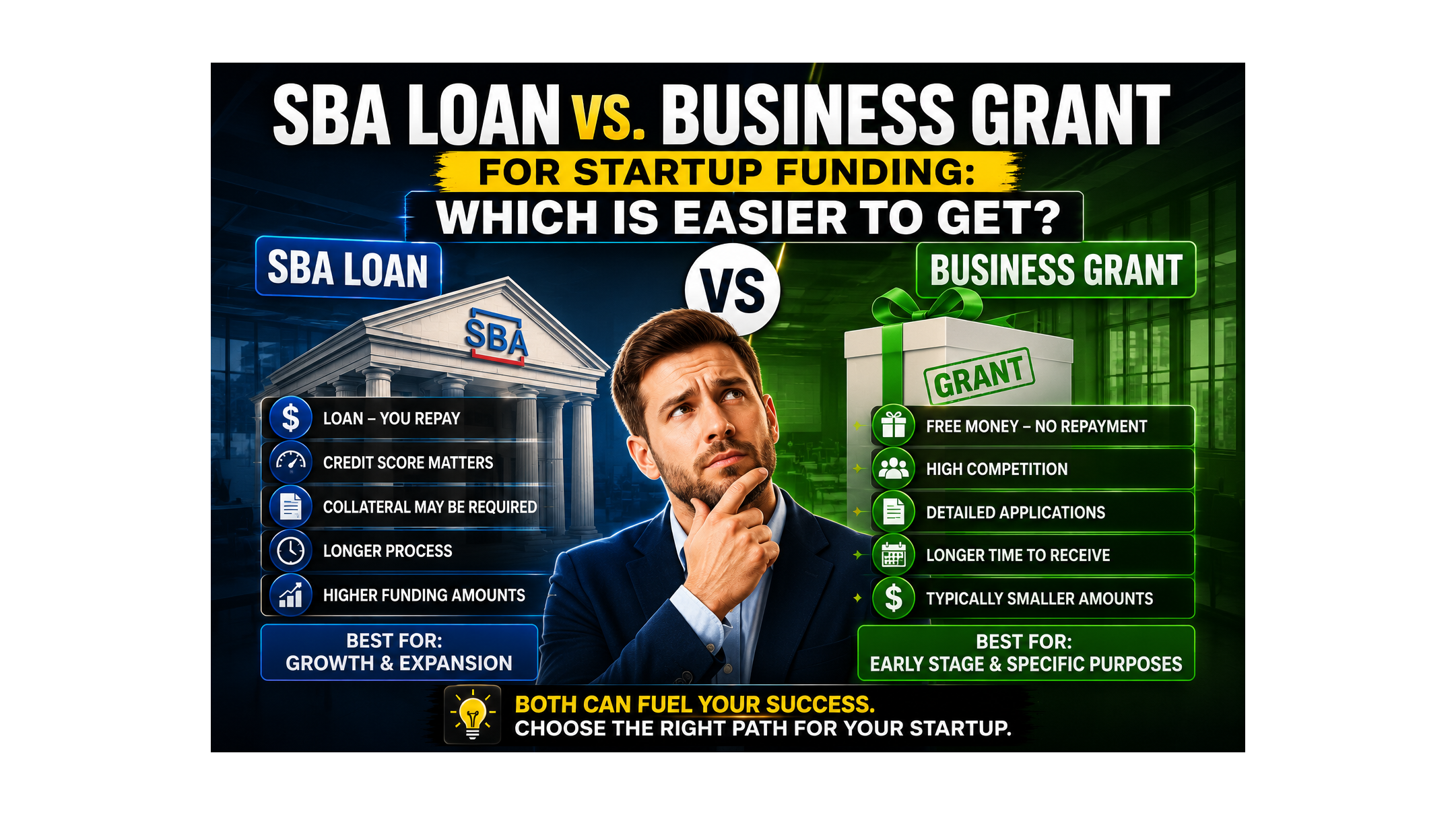
Key Takeaways
- SBA loan guarantees are not direct government loans – the SBA backs the lender, reducing their risk so they’ll approve businesses that might not qualify otherwise.
- Research grants like SBIR and STTR are non-dilutive, require no repayment, and don’t claim your IP – but they’re highly competitive and built specifically for R&D-focused startups.
- The right funding path depends heavily on your startup type: a tech hardware company and a local service business have very different options available to them.
- BUSINESS FUNDING INSIDER breaks down funding mechanisms like these so founders can make informed decisions – see what’s available at g2gventures.com.
- Understanding the real costs – personal guarantees, approval timelines, and application demands – can determine whether either option is realistic for your stage.
Every startup founder hits the same wall: how do you raise capital without giving up a slice of your company? Two options that often come up are SBA loan guarantees and government research grants. They sound similar on the surface – both involve some form of government involvement – but they work in completely different ways and serve very different types of businesses.
Two Paths, One Goal: Capital Without Giving Up Equity
The appeal of both SBA loans and research grants comes down to one thing: non-dilutive funding. Neither requires handing over equity to an investor. That’s roughly where the similarities end. One is debt that must be repaid with interest. The other is money awarded for scientific work that never has to be paid back. Choosing between them isn’t about which is better – it’s about which fits the specific startup, its industry, and its stage of development.
SBA Loan Guarantees Aren’t What Most Think
There’s a common misconception worth clearing up: the SBA doesn’t give money directly to businesses. The U.S. Small Business Administration acts as a guarantor – it promises to repay a portion of the loan to the lender if the borrower defaults. This reduces the lender’s risk, which makes them more willing to approve loans for startups and small businesses that wouldn’t meet traditional bank lending criteria.
In short, the government backs the lender, not the founder.
The Government Backs the Lender, Not You
Because private lenders still originate and service these loans, the experience feels more like a bank loan than a government program. The lender sets most of the terms within SBA guidelines, and the SBA’s involvement is largely behind the scenes. The practical benefit for founders is access to more flexible qualification requirements, competitive interest rates, and longer repayment windows – up to 10 years for working capital and up to 25 years for real estate.
Microloans Lead for Startups, But 7(a) and 504 Serve Different Needs
Three SBA programs dominate the conversation for early-stage businesses:
- SBA 7(a) Loans – The most common program, covering a wide range of business purposes with loan amounts up to $5 million.
- SBA 504 Loans – Designed for purchasing fixed assets like commercial real estate or heavy equipment, not for general working capital.
- SBA Microloans – Capped at $50,000, these are specifically aimed at startups and small businesses with limited credit history, making them the most accessible entry point for early-stage founders.
For most brand-new startups, the Microloan program is the realistic starting point. The 7(a) and 504 programs become more relevant once a business has some operating history to show lenders.
The Real Costs of an SBA Loan
Longer terms and flexible requirements don’t mean SBA loans are without teeth. There are two major considerations every founder should understand before applying.
Personal Guarantees Put Your Assets on the Line
Any owner holding 20% or more equity in the business is typically required to sign a personal guarantee. That means if the business can’t repay the loan, personal assets – home, savings, car – can be used to satisfy the debt. This detail catches founders off guard more often than it should. It shifts real financial risk from the business onto the individual.
Most SBA Loans Take 30-90 Days From Application to Funding
Speed is another honest limitation. The SBA loan process involves the lender, the SBA itself, and significant documentation – financial statements, business plans, tax returns, and more. From application to funded account, the timeline typically runs 30 to 90 days. For a startup facing urgent capital needs, that window can be a dealbreaker.
Research Grants Are a Different Beast Entirely
Government research grants – particularly the Small Business Innovation Research (SBIR) and Small Business Technology Transfer (STTR) programs – exist in a completely different funding category. Collectively marketed as America’s Seed Fund, these programs were designed specifically to fuel early-stage scientific research and development in startups.
SBIR and STTR: Built for Deep Tech and R&D Startups
SBIR and STTR grants are not general-purpose business funding. They target startups working in deep tech, AI, biotechnology, advanced materials, aerospace, and similar frontier fields – industries where the research itself carries significant national or commercial value. A startup building a SaaS scheduling tool won’t qualify. A startup developing a novel diagnostic biosensor very well might.
The distinction between SBIR and STTR comes down to collaboration: STTR requires a formal partnership with a research institution such as a university or federal lab, while SBIR does not.
Phase I and Phase II Funding Ceilings Vary by Agency
Both programs operate in structured phases:
- Phase I – Proof of concept funding, ranging from approximately $50,000 to $323,090 depending on the awarding agency.
- Phase II – Technology development funding for companies that demonstrated feasibility in Phase I, ranging from approximately $750,000 to $2,153,927.
Different federal agencies – including the NIH, NSF, DoD, and DOE – administer their own SBIR/STTR competitions with varying award sizes within these ranges. There is no single universal ceiling; founders must research the specific agency relevant to their technology.
Grants Don’t Repay – But They’re Not Easy Money
No Repayment, No Equity Lost, No IP Claimed
The core appeal of SBIR and STTR grants is hard to overstate: the money never has to be repaid, no equity changes hands, and the government does not claim ownership of any intellectual property developed through the grant. The startup retains full control of what it builds. That makes these grants genuinely non-dilutive in every meaningful sense. Winning one can also significantly strengthen credibility, often attracting follow-on private investment from VCs who view federal validation as a strong signal.
A documented example: a biotech startup focused on innovative healthcare solutions secured a government grant that accelerated its R&D, leading to a groundbreaking medical device. The funding also connected the team with healthcare experts and ultimately contributed to measurable market success.
Highly Competitive With Demanding Applications
The tradeoff is real. SBIR and STTR grants are intensely competitive. Applications require detailed technical narratives, commercialization plans, principal investigator qualifications, and ongoing progress reporting once awarded. The timeline from application to award can stretch months. Many strong applicants are rejected in the first round and must iterate and reapply. For founders without a research background or technical writing experience, the process can feel like learning a new language under pressure.
SBA Loans vs. Research Grants: A Direct Comparison
Factor SBA Loan Guarantees SBIR / STTR Research Grants Repayment Required Yes – with interest No Equity Given Up No No IP Ownership Retained by business Retained by business Personal Guarantee Usually required (20%+ owners) Not applicable Funding Amount Up to $50K (Microloan) / $5M (7a) $50K-$2.15M across phases Timeline to Funding 30-90 days Months (varies by agency) Who Qualifies Most small businesses R&D / deep tech startups only Competitiveness Moderate Very high
Your Startup Type Determines the Right Fit
There’s no universal winner here. The right funding mechanism comes down to what the startup actually does and what stage it’s in.
- If the startup is building a product or service that doesn’t involve scientific R&D – a retail business, a service company, a consumer app – SBA loans (especially Microloans) are the more practical path. They’re accessible, flexible, and don’t require a research agenda.
- If the startup is developing technology with scientific merit and commercialization potential – particularly in biotech, deep tech, or advanced engineering – SBIR and STTR grants are purpose-built for exactly that work. No repayment and no equity loss make them extraordinarily valuable if the startup can compete.
- In some cases, both are viable at different stages – a deep tech startup might pursue an SBIR Phase I grant early on, then use that federal validation to qualify for an SBA 7(a) loan when scaling operations.
The decision isn’t just financial – it’s strategic. Founders should map their funding path to their business model, not the other way around.
For more breakdowns on startup funding mechanisms, BUSINESS FUNDING INSIDER publishes founder-focused analysis to help you find the capital path that fits your business.
BUSINESS FUNDING INSIDER
15622309760
30300 Antelope Road
UNIT 1426
Menifee
CA
92584
United States


